Welcome to Issue #13 of TAIS, where every Friday we spotlight visionary changemakers reshaping Africa’s tech, data, and AI landscape, one breakthrough at a time.
In today's issue, we feature Pitshou Biongo Mputu, a France-based Congolese telecommunications engineer and entrepreneur whose work exemplifies the intersection of diaspora expertise and continental infrastructure development.
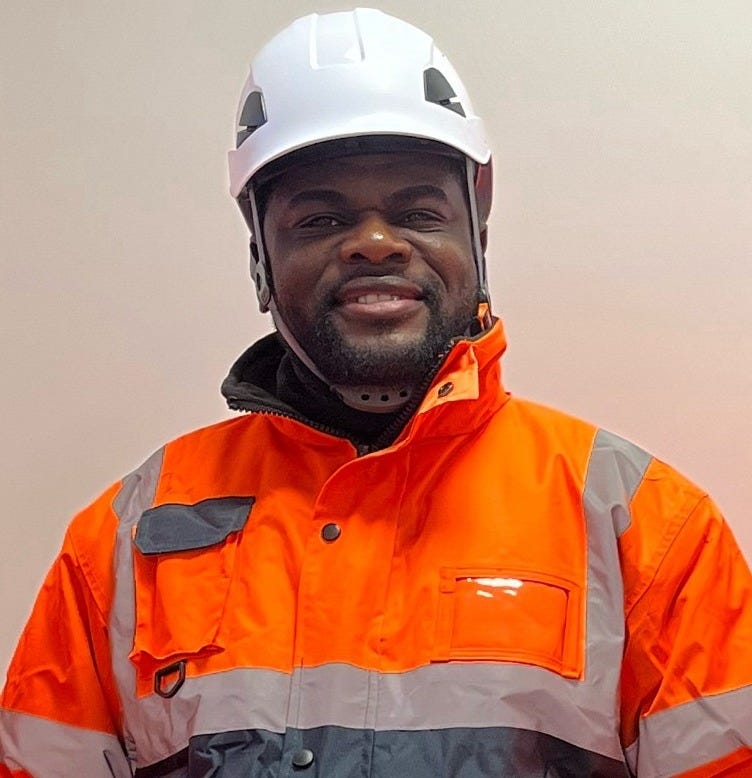
Pitshou Biongo Mputu | CEO of CÉLÉRITÉ & Adjunct Instructor of Telecom Network Components & FTTH at the University of Lille Cité Scientifique.
Through his company CÉLÉRITÉ, which specializes in mobile radio site development and network deployment, Pitshou represents a new generation of African tech professionals who leverage European technical training to address fundamental infrastructure challenges in their home countries focusing on building and maintaining the foundational mobile network infrastructure that enables broader digital transformation rather than competing in saturated application markets.
Understanding the Technical Work
Before diving into the broader implications of Pitshou's work, it's worth understanding what CÉLÉRITÉ does on a day-to-day basis. As a company specializing in mobile radio site development, CÉLÉRITÉ handles the complete lifecycle of mobile network infrastructure from initial site planning through ongoing maintenance.
When(further below) Pitshou describes his role in "mobile radio site development" and "load calculations and mobile network dimensioning," he's talking about the fundamental engineering that makes our mobile phones work. Every time we make a call or use mobile internet, our phones connect to a cell tower. CÉLÉRITÉ's work involves the entire process, which involves deciding where to place these towers, installing the equipment, configuring the technical settings, and maintaining the infrastructure so our phones can reliably connect.
Load calculations involve determining how many people will use the network simultaneously and how much data they'll consume. It's like planning a highway system where you need to know how many cars will use each road during rush hour to build the right number of lanes. Get it wrong, and you have network congestion, dropped calls, and slow internet.
Network dimensioning is the planning phase where engineers determine what equipment to install and where to place it to ensure optimal coverage and performance. Think of designing a water distribution system for a city, you need the right infrastructure in the right places, so everyone gets adequate service.
These technical fundamentals are critical because poor planning results in dropped calls, slow internet, and dead zones. In developing telecommunications markets, getting these basics right can determine whether entire communities have reliable communication or remain digitally isolated.
This infrastructure work becomes even more crucial in our current digital era. As AI applications, mobile banking, telemedicine, and digital education platforms proliferate, they all depend on the same underlying mobile networks that Pitshou helps build and maintain. Without reliable cellular infrastructure, ambitious digital transformation initiatives from government e-services to fintech innovations simply cannot reach the populations they're designed to serve. The engineers doing this foundational work are essentially determining which communities will participate in the digital economy and which will be “left behind”.
From Kinshasa to Lille
Pitshou's evolution within telecommunications infrastructure reflects strategic specialization that mirrors broader shifts in how African engineers position themselves in global tech markets:
After an engineering background in Electronics Radio-Transmission that I obtained in Kinshasa in the Democratic Republic of Congo, I made a turn toward digital technology. Following this, I obtained another engineering degree in Computer Networks and Telecommunications at the University of Artois. During my professional career, I was led to work on projects combining electronics and wireless communication. This developed in me a passion for telecom networks. Thus, I chose the University of Lille’s scientific campus because the program I had applied for corresponded exactly to my professional project.
This trajectory illustrates strategic skill arbitrage, leveraging foundational African technical education as a platform for European specialization, then applying that enhanced expertise to continental infrastructure opportunities. His dual role as CÉLÉRITÉ founder and University of Lille lecturer exemplifies a new model of diaspora engagement: maintaining academic presence in advanced markets while capitalizing on practical opportunities in emerging ones. This positioning provides access to diverse telecommunications knowledge while remaining commercially positioned for Africa's rapidly expanding infrastructure markets.
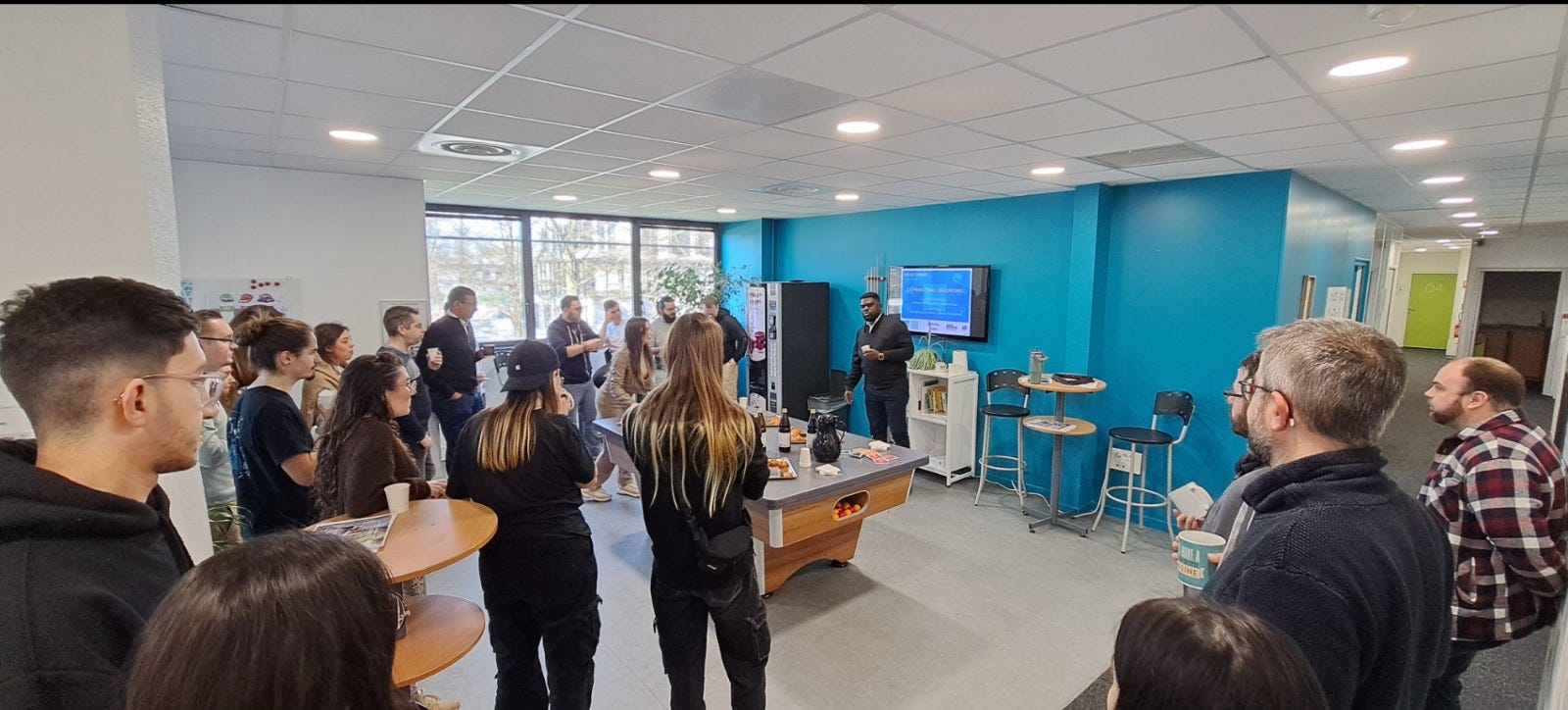
Pitshou delivering a CÉLÉRITÉ pitch presentation
The Actor-Consumer Paradigm
Perhaps the most significant insight from this conversation centers on educational philosophy and technological agency:
Structural reforms are needed and campaigns for mindset change, particularly in African education systems. Young Africans must change their approach, they must position themselves as actors; not as consumers. Indeed, teaching methods in Africa would need to be reviewed to stimulate technological curiosity among young people.
This observation emerges from direct comparative experience between French and Congolese educational systems:
The difference between educational approaches in France and those of the Democratic Republic of Congo is at several levels: France has a more structured, stable system supported by the State, with modern educational resources. On the other hand, the DR Congo still suffers from infrastructure problems, teacher training, and equitable access to education. In this context, I would say that poor governance has weakened the education of the Congolese elite.
This "actor versus consumer" distinction gets to the heart of why many African countries have millions of mobile phone users but few mobile infrastructure companies. Educational systems that prioritize technology consumption over technology creation produce graduates who can use smartphones and computers but lack the engineering skills to design cellular networks or manufacture hardware. The result is technological dependency: importing expertise for critical infrastructure projects while local talent remains underutilized.
Pitshou's critique suggests that African educational institutions often focus on training students to navigate existing technologies rather than questioning how those technologies work or could be improved. This pedagogical approach, while practical for immediate employment needs, limits long-term technological sovereignty. Countries end up with large populations of digitally literate consumers but insufficient numbers of engineers, network architects, and technical entrepreneurs capable of building the digital infrastructure that underpins modern economies.
The implications extend beyond individual career outcomes to national competitiveness. Without educational systems that cultivate technological curiosity and problem-solving capabilities, African countries will continue depending on foreign expertise for critical infrastructure development, limiting their ability to capture value from the digital economy they're helping to build through consumption.
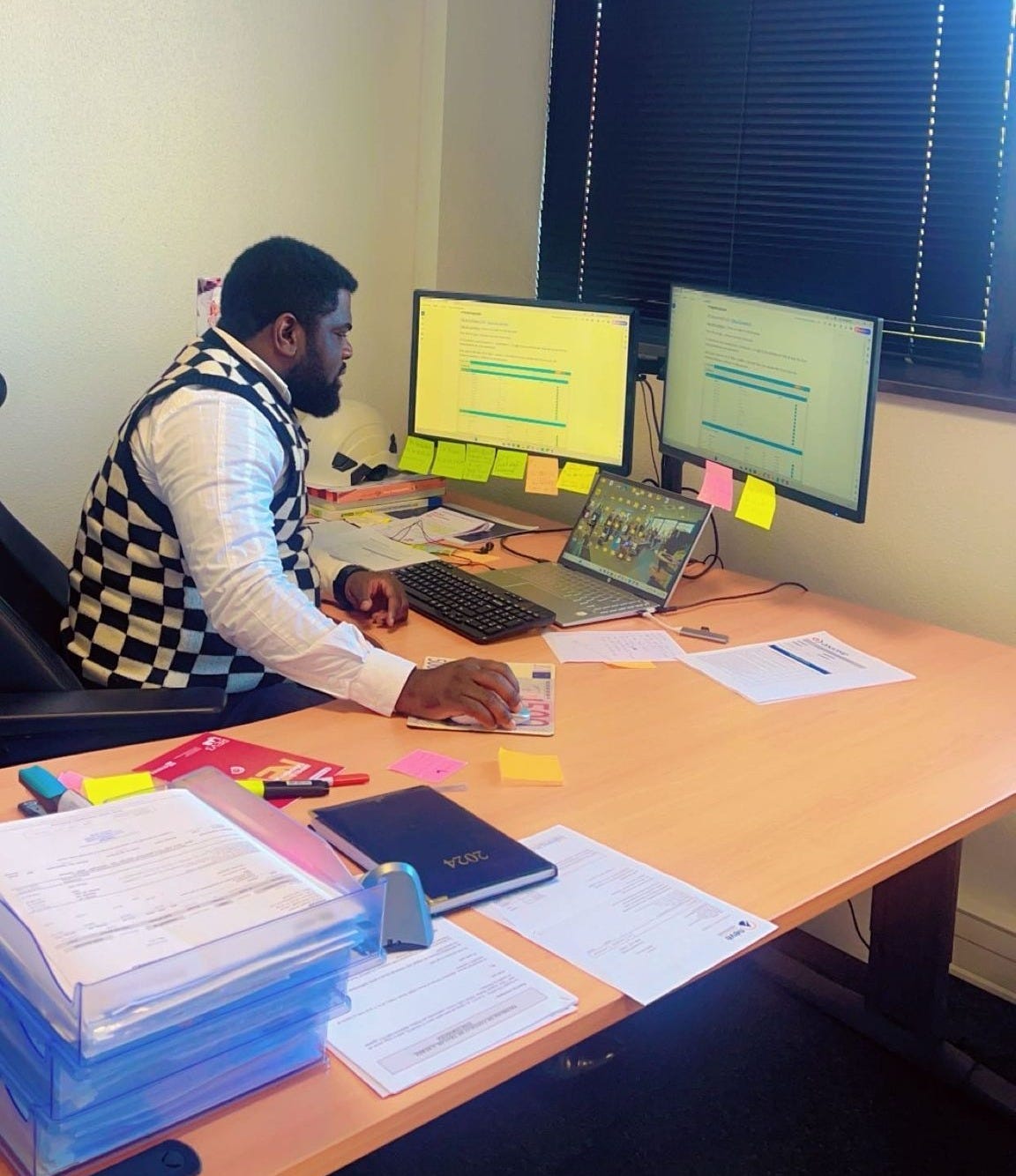
Pitshou working at his desk
Building Infrastructure Expertise
Pitshou's current work illustrates the technical depth required for telecommunications infrastructure:
I work on mobile radio site development. Right now, I am projecting myself onto load calculations and mobile network dimensioning.
These are foundational engineering tasks that determine whether mobile networks function effectively. Pitshou's work demonstrates this technical depth by positioning himself, through CÉLÉRITÉ as a technical service provider rather than just a contractor, competing on specialized expertise rather than low costs alone.
The broader significance lies in what this reveals about African tech entrepreneurship. While much attention focuses on software startups and fintech innovations, the fundamental infrastructure work, the engineering that makes digital services possible, often gets overlooked. Yet this is where some of the most critical expertise gaps exist. African countries importing telecommunications equipment still rely heavily on European or Asian engineers for complex installations and optimizations.
Pitshou's positioning suggests a pathway for African professionals to capture more value in the telecommunications supply chain. Rather than simply providing labor for equipment installation, companies like CÉLÉRITÉ develop specialized engineering capabilities that allow them to work as technical partners with major manufacturers. This represents a shift from service provision to technical expertise, a move up the value chain that could be replicated across other infrastructure sectors.
Continental Applications
The cross-border dimension of Pitshou's work becomes evident in his FTTH involvement:
Indeed, I have already been approached by GTMEEF, a partner company of SOCOF (Société Congolaise de la Fibre Optique), to work on the FTTH (Fiber to the Home) very high-speed network deployment project.
Pitshou exiting an entrepreneurship meetup session in France
This collaboration represents a compelling case of European-acquired telecommunications expertise being directly applied to DRC infrastructure development. Pitshou's potential involvement with SOCOF(the Congolese Fiber Optic Company) illustrates how diaspora knowledge transfer operates at a practical level, bypassing traditional development paradigms that rely on policy recommendations or external consultants.
The model demonstrates organic technology transfer: specialized skills acquired in European markets deployed immediately to address infrastructure gaps at home. Rather than international organizations bringing in foreign experts, it represents indigenous expertise, technically sophisticated yet culturally grounded, applied directly to local challenges. Pitshou's background provides not just technical knowledge, but familiarity with European regulatory standards and project management practices adaptable to the Congolese context.
Such partnerships suggest a paradigm shift in South-North-South knowledge flows, where diaspora professionals serve as bridges for practical, immediately applicable technical expertise, potentially more effective than traditional development assistance models for accelerating infrastructure development.
Digital Assessment
When discussing the DRC's global digital position, Pitshou offers a measured response:
I think the National Institute of Statistics (DR Congo) would be best placed to answer this question. But, if I had to give an opinion on a scale of 1 to 10, I would say that the DR Congo is well below average.
This assessment, while blunt, reflects the kind of baseline honesty necessary for productive technology policy discussions, a candor often absent from diplomatic exchanges or development sector rhetoric that tends to emphasize progress over persistent challenges. Pitshou's response demonstrates intellectual humility by first deferring to official statistical authorities while simultaneously providing a frank evaluation based on direct operational experience. This dual approach, acknowledging institutional expertise while offering personal insights, suggests the kind of evidence-based thinking that effective infrastructure development requires.
Having operational experience in both European and African telecommunications contexts provides Pitshou with a comparative framework that many policy discussions fundamentally lack. Unlike academic assessments or consultant reports that may rely primarily on secondary data, this perspective emerges from hands-on implementation experience across different regulatory environments, market structures, and infrastructure baselines. This comparative lens enables a more nuanced understanding of what "digital development" actually entails in practice, not just connectivity statistics or mobile penetration rates, but the underlying technical, regulatory, and economic foundations that determine whether digital infrastructure can be sustainably deployed and maintained.
Such grounded comparative analysis becomes particularly valuable in contexts where development discourse often operates in abstractions, disconnected from the practical realities of building and maintaining telecommunications networks in challenging environments.
AI and Infrastructure Optimization
On artificial intelligence, Pitshou's perspective remains grounded in immediate applications:
AI is a real lever for growth and efficiency in managing and automating mobile radio cells. AI has no direct implications for CÉLÉRITÉ. On the other hand, it allows ISP operators, our clients, to optimize certain operations, automate repetitive tasks, and analyze data in a short time.
Pitshou sees AI as benefiting network operators, his clients, rather than his own company. He distinguishes between physical infrastructure (CÉLÉRITÉ's work) and managing networks intelligently (where AI helps his clients). This makes sense from his current business model. CÉLÉRITÉ focuses on installing mobile radio sites, while AI tools help operators manage those sites once they're operational.
However, AI could potentially impact site development too, through optimized site selection, predictive maintenance planning, or automated monitoring during construction. Pitshou may be taking a conservative view, focusing on proven applications rather than emerging possibilities, which is understandable for a company operating in a challenging infrastructure environment where reliable execution matters more than cutting-edge technology integration. His response reflects practical prioritization: get the basic infrastructure built first, let clients worry about intelligent optimization later.
But this raises an interesting question: as AI tools become more accessible and infrastructure deployment becomes increasingly data-driven, will companies like CÉLÉRITÉ need to integrate intelligent systems into their operations to remain competitive?
Educational Integration
The dual role as entrepreneur and university lecturer creates interesting dynamics around knowledge transfer:
Practical skills must be developed and make young people actors in digital transformation. Spaces for participation must be opened, tech entrepreneurship supported, and inclusive access to digital resources ensured.
This vision for higher education reform emerges from lived experience across French and Congolese academic systems. Pitshou's emphasis on practical skills over theoretical frameworks, and entrepreneurship support over traditional academic pathways, reflects intimate knowledge of both systems' limitations. His call for "inclusive access" and "participation spaces" suggests specific institutional gaps identified through comparative analysis, where European technical training effectiveness contrasts with African institutional constraints. The focus on making students "actors" rather than recipients of digital transformation reveals a pedagogical philosophy shaped by entrepreneurial practice.
Train yourselves, surround yourselves, share your knowledge. Africa has no delay if it takes the initiative to build its own model. You are that force. The digital future of the continent belongs to you.
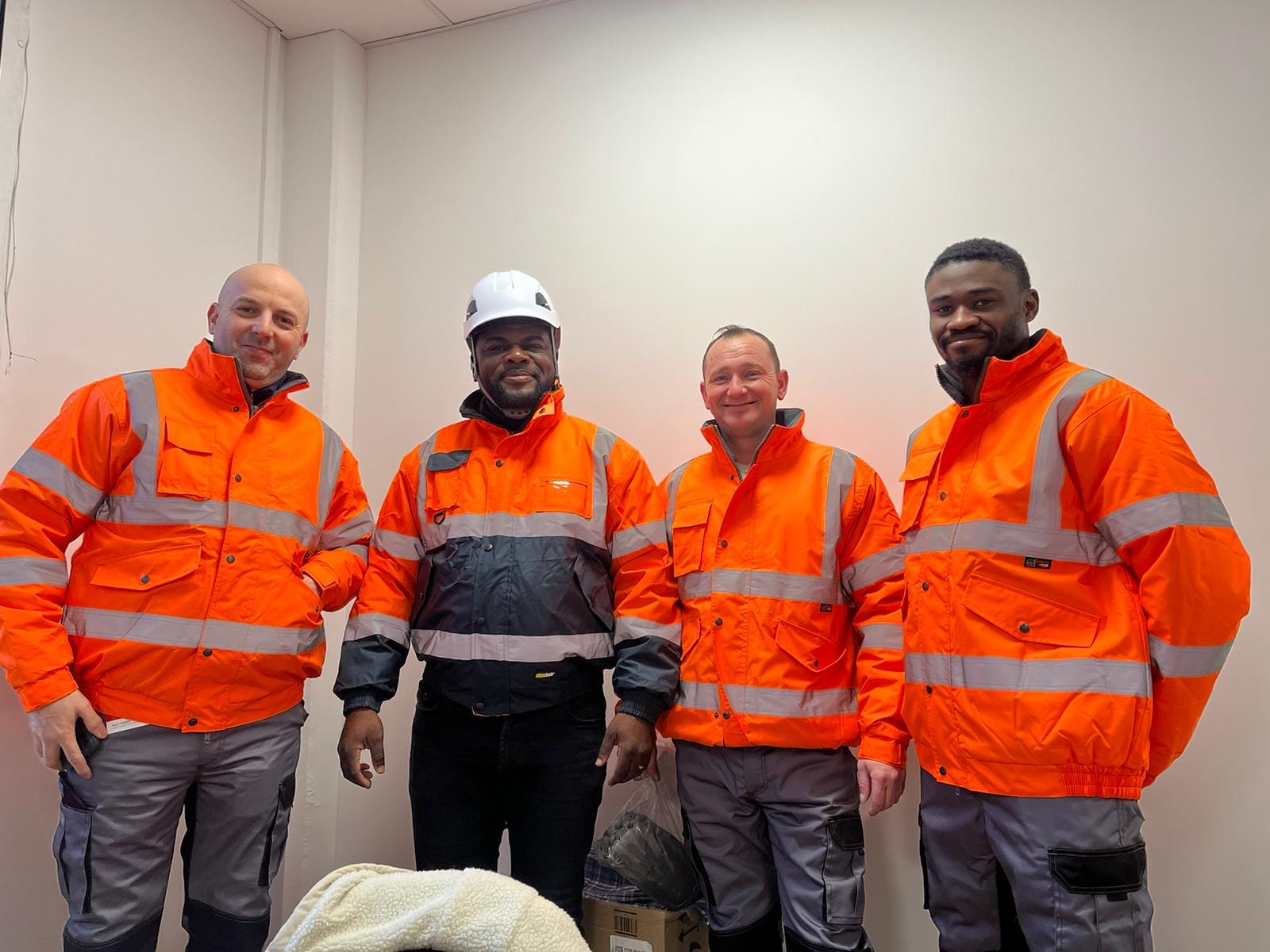
Pitshou alongside his colleagues
Pithsou’s point about Africa having "no delay" is interesting. Countries building networks from scratch today can use the latest technology, while older systems remain stuck with legacy infrastructure.
Infrastructure-First Approach
What emerges from this conversation is a profile of African tech development that prioritizes fundamental infrastructure over application-layer innovation. While much African tech discourse focuses on fintech, e-commerce, and consumer applications, entrepreneurs like Pitshou work on the underlying telecommunications systems that enable everything else.
This infrastructure-first approach : mastering network optimization, fiber optic deployment, and mobile radio site development represents a different pathway for African tech leadership. Rather than competing in crowded application markets, it focuses on building the foundational systems that support broader digital transformation.
The CÉLÉRITÉ model suggests sustainable approaches to African tech entrepreneurship: technically specialized, maintaining manageable scale, competing on expertise rather than venture capital, and directly addressing infrastructure gaps that limit broader digital development.
This perspective on African tech development emphasizes building from the ground up, literally, in the case of telecommunications infrastructure, rather than importing solutions designed for different contexts. It's a more gradual but potentially more sustainable approach to continental digital transformation.
Questions for Reflection
As we consider Pitshou's journey and his work bridging European expertise with African infrastructure opportunities, several questions emerge for our readers:
For African tech professionals in the diaspora: How might you leverage your dual perspectives and technical training to address infrastructure gaps in your home countries? What barriers prevent more diaspora professionals from pursuing infrastructure-focused entrepreneurship over application-layer startups?
For those working in African tech ecosystems: Does the emphasis on fintech and consumer applications overshadow the foundational infrastructure work that enables digital transformation? How can we better support and celebrate the "unglamorous" engineering that makes everything else possible?
For global tech professionals and investors: What can other regions learn from the infrastructure-first approach that professionals like Pitshou advocate? How might this model of building foundational systems before applications challenge conventional tech development wisdom in your context?
For educators and development practitioners worldwide: How do educational systems in different contexts either encourage or discourage students to become "actors rather than consumers" of technology? What role should international partnerships play in building technical capacity without creating dependency?
This newsletter is independently researched, community-rooted, and crafted with care.
Interested in sponsoring or partnering with me? Get in touch📩 reambaya@outlook.com
…and/or click on the image below to sponsor my next article with a one-time contribution!